Will Eaton
Assistant Professor in Seismology
Utrecht University






Assistant Professor in Seismology
Utrecht University
I am an Assistant Professor at Utrecht University having completed my PhD at Princeton University. My research interests are in geophysical numerical modelling, predominantly in seismology and geodynamics.
Outside of academia my heart lies in exploring nature, watching Liverpool FC and a good cup of tea.
You can find more details on my research interests and projects below. Feel free to contact me for a chat about anything geophysical!
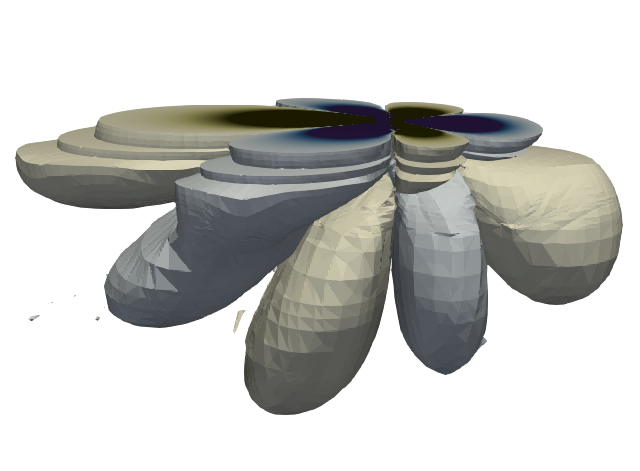
Earth's normal modes and the ways in which they 'split' are observables for studying Earth's internal structure. In particular my research focusses on studying the anisotropy, or directional dependence, of material properties in Earth's inner core. This includes development of novel software, NMSplit90, to compute normal-mode splitting effects due to tilted, transverse anisotropy, as well as a transdimensional Bayesian MCMC toolkit for inverting the interior structure.
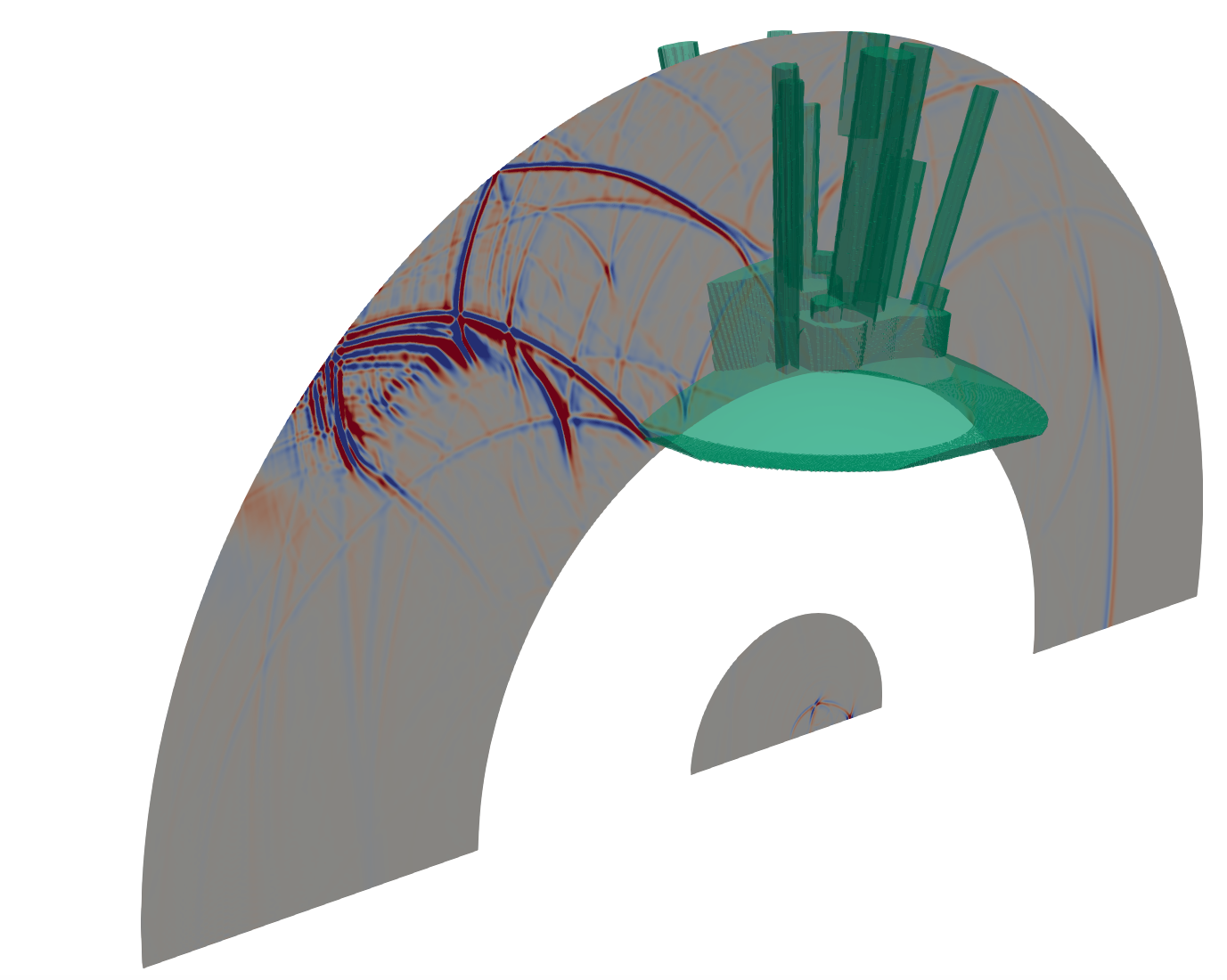
Modelling Earth's gravitational potential field is of significant interest for both geodynamic forward and inverse problems. The fact that potential fields, unlike other fields such as displacement, are non-zero outside of a body has provided a challenge for numerical modelling as infinite space can not be meshed. This has placed limitations on numerical modelling of geodynamic processes occurring over long timescales which require consideration of gravitational forces.
SPECFEM-X, developed by Hom Nath Gharti and Jeroen Tromp, incorporates gravitational potential fields into SPECFEM-GLOBE using a spectral infinite-element method to solve the Laplace equation in an unbounded spatial domain (see Gharti et al 2018). This refinement enables modelling of 3D quasi-static and elastic problems involving all the features of SPECFEM-GLOBE, but with the additional capability to accurately model spatio-temporal changes to the gravitational field.
My research involves utilising this new toolkit to simulate prompt elasto-gravitational signals (PEGS), Earth's nutations and wobbles, as well as visco-elastic modelling of sea-level change. This work was published in Geophysical Journal International, and can be found here.
Click here for PEGS sensitivity kernels, and here for Prompt Gravity-Strain signals (PGSS) sensitivity kernels. .
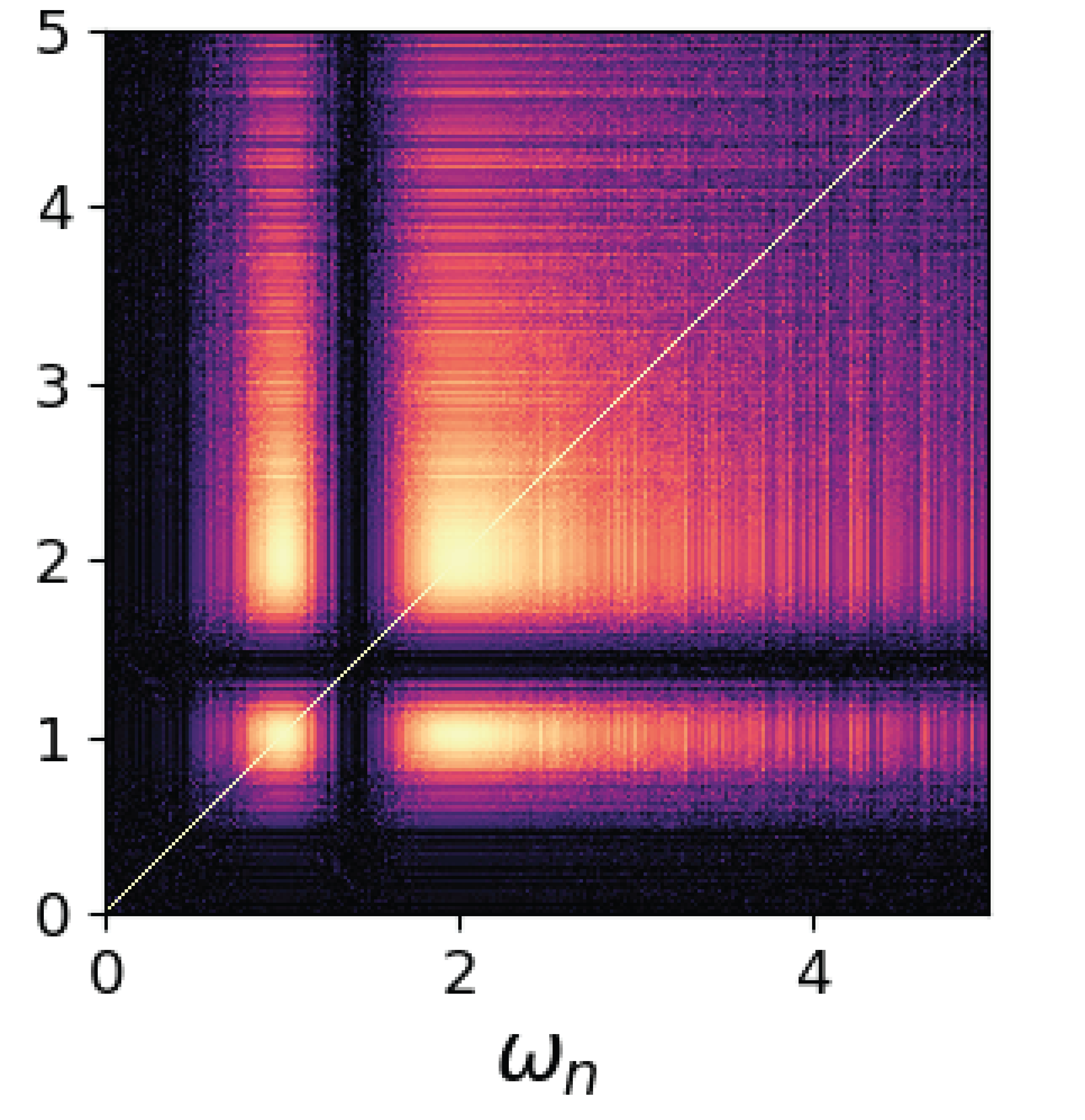
Seismic-wave scattering is observed, to variable degrees of strength, on all planetary bodies for which seismic records exist (e.g. from the InSight and Apollo missions). Global-scale imaging using scattered wavefields is capable of resolving structure orders-of-magnitude smaller than is possible using traditional inversion methods such as tomography. Current scattering models and analytical methods are limited to two end-member phenomena: weak single- or multiple-scattering events (ballistic), or intense scattering such that the wavefield retains no phase information (diffuse). My research explores the existence of scattering behaviour intermediate between these end-members, and the dominant properties of heterogeneous media that facilitate a transition between them.
For more details, our manuscript can be found here.
Pretty much any useful codes I have written can be found on my Github. It's also where this website is stored and hosted! I aim to maintain publically-accessible codes however (in)complete. This means some of the repositories are still under construction, so please contact me with any questions! Click on any of the projects below to find out more:
Please feel free to get in touch about anything on my website, or any queries you may have! You can email me at w.p.eaton@uu.nl or connect with me on any of the platforms below: